March 4, 2026
Ramin Popal
You've built your product list, found suppliers, and you're ready to learn how to succeed in dropshipping, but now you're stuck choosing the right platform to power your online store. BigCommerce might seem like the obvious choice, yet many new store owners quickly discover that its pricing tiers, learning curve, and feature limitations can create unexpected roadblocks. This article walks you through the best BigCommerce alternatives for new store owners, comparing ecommerce platforms like Shopify, WooCommerce, Wix, and specialized dropshipping solutions that might better match your budget, technical skills, and business goals.
Finding the right platform shouldn't mean spending weeks researching API integrations, payment gateways, and inventory management systems. AI Store Builder offers a streamlined approach that eliminates much of this complexity, letting you launch a fully functional dropshipping store without wrestling with themes, plugins, or complicated setup processes. The tool handles the technical foundation so you can focus on what actually grows your business: finding winning products, building customer relationships, and refining your marketing strategy.
AI Store Builder creates functional dropshipping stores in under 10 minutes by automatically handling product selection, supplier vetting, and technical configuration, letting new sellers focus on marketing and customer acquisition instead of spending weeks on setup tasks.
BigCommerce assumes you already know what you're doing. It's built for businesses with existing revenue, technical teams, and clear scaling plans.
For someone launching their first store, that assumption becomes a liability. You're handed tools designed for complexity when what you need most is clarity and momentum.
The platform offers depth that sounds impressive on paper. Multi-channel selling, advanced API access, customizable checkout flows, and granular tax configurations all signal sophistication. But sophistication without context creates paralysis.
When you're still figuring out whether your first product will sell, you don't need 47 payment gateway options or headless commerce architecture. You need a store that converts visitors into buyers. BigCommerce gives you the steering wheel of a commercial airliner when you're still learning to drive.
BigCommerce offers 12 free themes, which sounds generous until you realize each one requires significant customization to look professional. You'll spend hours adjusting fonts, colors, layouts, and mobile responsiveness. Every design decision branches into three more decisions. The clock runs while your store sits unfinished.
The real cost isn't just time. It's the opportunity cost of delaying your launch while you tinker with settings that won't materially affect your first hundred sales. Beginners often mistake busy work for progress. Adjusting theme padding feels productive, but it doesn't teach you which products resonate or how to write copy that converts.
Most new sellers underestimate how much manual work remains after choosing a platform. You still need to source products, vet suppliers, write descriptions, set pricing, configure shipping rules, and build trust signals into your design. BigCommerce doesn't automate any of that foundational work.
According to Chargeflow, the platform's average revenue per account climbed 9% to $45,290 in recent data, which tells you exactly who the platform serves. Those numbers reflect established businesses with existing customer bases and proven products. If you're starting at zero, you're paying for infrastructure built for companies already generating significant revenue.
Entry-level pricing seems reasonable until you calculate what actually running a store costs. Transaction fees apply unless you use specific payment processors. Each essential app for email marketing, abandoned cart recovery, and product reviews is available on a monthly subscription. A $29 plan quickly becomes $80 or $100 once you add the functionality needed to compete.
Many beginners pay these costs for months while still building their store. Revenue stays at zero while expenses accumulate. The pressure to launch perfectly increases because you're already invested. That pressure often leads to overthinking every detail, which further delays the only thing that matters at the start: getting real customers to interact with your offer.
Platforms like AI Store Builder take a different approach by handling product sourcing, supplier connections, and store setup automatically. Instead of spending weeks learning BigCommerce's architecture, you get a functional store with trending products already loaded, letting you focus immediately on marketing and customer acquisition rather than technical configuration.
The most successful first-time sellers don't start with the most powerful platform. They start with the fastest path to validation. Launch quickly, test products, learn what messaging works, then scale infrastructure as revenue justifies it.
BigCommerce optimizes for the wrong variables when you're just starting. It gives you control over everything when what you need is guidance on the few things that matter. Conversion rate optimization, product selection, and traffic generation will determine your success far more than checkout customization options.

A beginner-friendly ecommerce platform should prioritize speed, clarity, and revenue generation over feature depth. The faster someone can go from idea to live store, the sooner they can test demand, gather feedback, and iterate. Platforms that minimize setup steps and remove unnecessary technical decisions create momentum. Platforms that add layers of configuration create delay.
Weeks spent configuring themes or exploring settings delay the only metric that matters early on: real sales data. Every day your store remains in draft mode is a day you're not learning what messaging resonates, which products convert, or how customers actually behave. Perfection feels productive, but it's often procrastination in disguise.
The goal isn't to build the most sophisticated store. It's to build one that sells, then iterate from real data rather than assumptions. A simple store launched today will teach you more than a complex store launched three months from now.
One of the hardest parts of ecommerce is not building the website. It's choosing what to sell. Beginners benefit enormously from access to trending or proven product categories instead of starting with a blank slate. Pre-validated products reduce guesswork and shorten the learning curve around demand, pricing, and positioning.
Without this support, many new sellers waste time researching items that never convert. They spend hours scrolling through supplier catalogs, reading competitor reviews, and second-guessing their instincts. The paralysis of choice becomes its own barrier to entry.
Complex dashboards and enterprise workflows are unnecessary at the beginning. If managing orders feels overwhelming, scaling becomes impossible. New sellers need clear visibility into orders, straightforward fulfillment tracking, and easy access to customer details. Nothing more.
The moment order management becomes a puzzle, energy shifts from growth to maintenance. You're solving problems that shouldn't exist yet.
Design does not need to be elaborate. It needs to convert. According to Baymard Institute, 69% of online shoppers abandon their carts, often because of friction in the checkout process or unclear trust signals. Clean product pages, clear calls to action, trust-building elements, and mobile-friendly layouts matter far more than aesthetic sophistication.
Many first-time sellers overinvest in aesthetics while neglecting the structure that drives purchases. They obsess over font pairings and color gradients while their product descriptions remain vague and their checkout flow requires six steps. Visual appeal attracts attention. Conversion structure captures revenue.
Beginners are often not developers. Requiring code edits, advanced integrations, or complicated plugin stacks increases the likelihood of frustration. A beginner-friendly system minimizes technical friction, allowing energy to be directed toward marketing and customer acquisition.
The traditional approach asks new sellers to become part-time web developers before they've made their first sale. They're expected to troubleshoot CSS, configure API keys, and debug payment gateway errors. That's not learning ecommerce. That's learning web development while trying to launch a business.
Platforms like AI Store Builder handle product sourcing, supplier connections, and store setup automatically. Instead of spending weeks learning platform architecture, you get a functional store with trending products already loaded. The technical barrier drops to nearly zero, allowing you to focus immediately on marketing and customer acquisition rather than on configuration panels.
Early-stage ecommerce is experimental. Not every product will succeed. Platforms with layered subscription tiers, paid apps, and hidden costs can put beginners at a financial disadvantage before revenue comes in. Lower startup costs reduce risk and allow testing without heavy upfront investment.
The pressure to launch perfectly increases when you're already invested. That pressure often leads to overthinking every detail, which further delays the only thing that matters at the start: getting real customers to interact with your offer.
In the early stages, the objective is validation, not optimization. Customization becomes valuable once a store has consistent traffic and sales. Before that, it often becomes a distraction. More features create more decisions. More decisions create more delay.
Beginners succeed when they launch quickly, test real products, learn from real data, and iterate based on results. The best ecommerce platform for a new seller is not the one with the most advanced capabilities. It's the one that gets them selling as fast and simply as possible.

Migration looks like progress. You're taking action, making a change, choosing something new. But most platform switches simply relocate the problem rather than solve it. The complexity doesn't disappear. It just wears a different interface.
The decision to leave BigCommerce often stems from legitimate frustration. Setup took too long. Features felt overwhelming. Costs crept higher than expected. But switching platforms without addressing the root cause of those frustrations means repeating the same cycle elsewhere, often with additional costs and delays piled on.
BigCommerce targets established brands with technical resources. Many of its direct competitors occupy the same market segment. They assume similar expertise, offer comparable feature depth, and require the same level of configuration work.
BuiltWith data shows BigCommerce powers over 45,000 live ecommerce sites globally. That footprint reflects deliberate positioning toward growth-focused businesses, not first-time sellers testing their first product. Platforms competing for that same audience rarely simplify the experience. They match it.
Base subscription pricing tells only part of the story. Most ecommerce merchants spend between $50 to $300 per month on third-party apps and integrations, according to pricing breakdowns from TrustRadius. That range reflects essential tools, not luxury add-ons.
Layer them together, and total monthly platform costs frequently exceed $200 before a single dollar goes toward advertising.
Every platform operates differently. Navigation patterns, terminology, settings hierarchy, and workflow logic vary significantly. What took you weeks to learn on BigCommerce becomes worthless knowledge when you migrate.
A 2023 survey from Clutch found that 27% of small businesses cite time investment as one of the biggest challenges when building or rebuilding a website. That time investment doesn't just mean clicking through setup wizards. It means understanding where settings live, how features interact, which apps play nicely together, and where to look when something breaks.
Switching ecommerce platforms does not automatically solve product validation or supplier selection. Those challenges exist independently of which software powers your checkout page. The global dropshipping market is projected to surpass $1 trillion by 2030, according to Grand View Research.
That scale reflects intense competition. In saturated markets, product selection and supplier reliability determine success far more than platform branding. Yet most platforms still require sellers to:
If product sourcing is your bottleneck, migration alone won't eliminate it. You're still scrolling through supplier catalogs, reading competitor reviews, and second-guessing which items might convert.
The platform change feels productive, but it doesn't address the core question every new seller faces:
Solutions like AI Store Builder take a different approach by pre-loading trending products with verified suppliers already connected, removing the research phase entirely. Instead of spending weeks vetting product categories and negotiating supplier terms, you start with items already showing market demand, allowing you to focus immediately on traffic and conversion rather than on sourcing and logistics.
Migration doesn't eliminate the foundational tasks required to launch. You still need to choose a theme, customize homepage layouts, build product pages, set up taxes and shipping zones, and test checkout flows.
Ecommerce onboarding benchmarks show first-time store builders commonly spend 20 to 40 hours on initial setup before launch. That estimate assumes everything goes smoothly. It doesn't account for troubleshooting payment gateway errors, fixing mobile responsiveness issues, or figuring out why shipping calculations display incorrectly.
Platform switching can solve specific problems, but only when the new choice directly addresses the original barrier. If BigCommerce felt too expensive, moving to a lower-cost alternative with similar functionality makes sense. If advanced features created confusion, migrating to a deliberately simplified platform removes that friction.
But emotional decisions rarely lead to strategic outcomes. Frustration makes any alternative look appealing. The grass appears greener because you're not yet standing in it, dealing with its own set of tradeoffs.

Entrepreneurs wanting a complete done-for-you store setup without technical work or product research should look here first. The service creates a functioning store in under 10 minutes, handling the entire setup process that typically consumes weeks. You receive 20 pre-selected trending products with established market demand, connections to trusted suppliers eliminating supplier search and vetting, and a comprehensive dropshipping course covering business fundamentals that other programs charge thousands for separately.
Live support calls provide direct assistance navigating challenges, while community access connects you with other store owners for shared learning and problem-solving. The done-for-you approach removes common barriers preventing people from starting. No design decisions. No product research paralysis. No supplier outreach. No technical setup.

Visually-oriented new owners prioritizing design flexibility and ease of use find traction here. Wix combines drag-and-drop website building with eCommerce functionality, allowing complete design control without coding knowledge. The visual editor shows exactly how your store will look as you build it, eliminating guesswork.
Wix powers over 200 million websites, reflecting its accessibility for non-technical users. Wix ADI (Artificial Design Intelligence) can generate complete store designs based on your answers to simple questions, accelerating setup for those overwhelmed by blank templates. Built-in marketing tools include email campaigns, social media integration, and SEO guidance.

New store owners seeking comprehensive features, a straightforward setup, and extensive support resources gravitate toward this platform. Shopify supports over 4.4 million stores, creating an enormous ecosystem of documentation, tutorials, and community knowledge. That scale means nearly every question you encounter has already been answered somewhere.
The platform provides an all-in-one eCommerce solution combining intuitive store building, integrated payment processing, inventory management, and marketing tools. The App Store offers thousands of extensions adding functionality as your business grows. Shopify handles technical infrastructure (hosting, security, updates), allowing you to focus on products and customers rather than server maintenance.

New owners with design sensibility wanting beautiful templates and straightforward selling find alignment here. Squarespace provides elegantly designed templates optimized for visual products like fashion, art, photography, and lifestyle goods. The platform emphasizes aesthetics while handling eCommerce essentials (product management, checkout, inventory tracking, order fulfillment).
Built-in blogging, email campaigns, and analytics support content marketing alongside selling. The interface prioritizes simplicity over exhaustive features, making it less overwhelming for first-time store owners. This suits creative entrepreneurs selling visually appealing products, those seeking stores that feel more like curated experiences than transactional websites, and new owners who prefer refined simplicity over feature abundance.

New owners already using Square for payments, or who want integrated online and in-person selling, should examine this option. Square Online offers free and paid eCommerce plans that integrate seamlessly with Square's payment processing and point-of-sale systems. For businesses already using Square readers at markets, pop-ups, or retail locations, adding online selling becomes remarkably simple. Products and inventory automatically sync across channels.
The free tier supports basic online selling with reasonable transaction fees, making it accessible for new owners testing concepts. Paid tiers add custom domains, advanced features, and lower transaction fees. This suits new sellers operating both online and offline, those wanting a simple setup without technical complexity, and budget-conscious owners appreciating the free tier option.
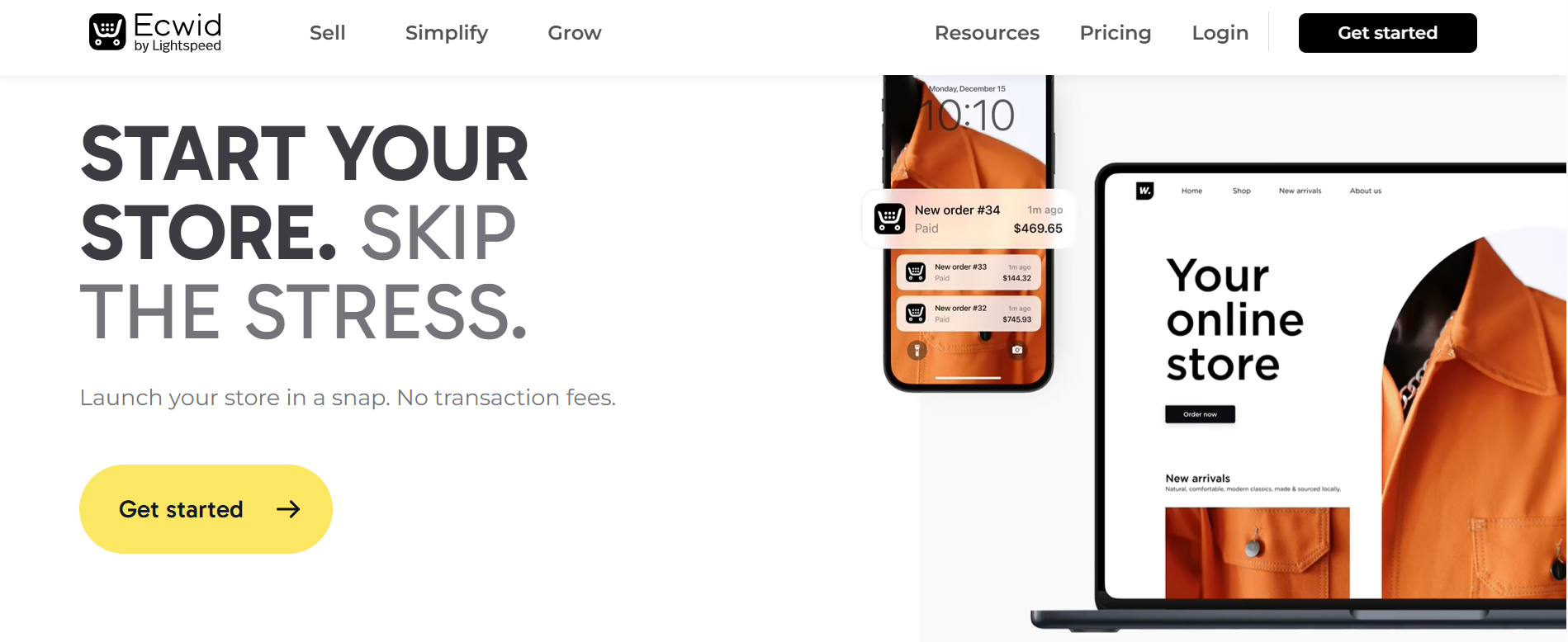
New owners wanting to add selling to existing websites, blogs, or social media should consider this approach. Ecwid functions as an embeddable store you add to existing WordPress sites, Wix, Weebly, social media pages, or virtually any website. You don't rebuild your existing online presence. You add selling functionality to what already exists.
The platform synchronizes inventory and orders across all channels:
From one control panel. Free plans support up to 10 products, paid plans scale as you grow. This suits new owners with established websites or blogs who want to add commerce, those selling primarily through social media who need cart functionality, and sellers managing inventory across multiple platforms.

Artists, crafters, and makers selling small inventories with minimal technical needs find simplicity here. Big Cartel specializes in simple stores for independent creators selling handmade goods, art, prints, apparel, or small product collections. The platform deliberately avoids overwhelming new users with complex features, focusing instead on straightforward selling.
Free plans support up to 5 products, making it genuinely accessible for testing markets. Setup takes minutes. Choose a theme, add products, connect payment processing, and launch. The simplicity means limited advanced features, but for new owners selling 5 to 50 products, those limitations rarely matter. This suits artists testing markets without investment, crafters selling at events who want an online presence, and new owners intimidated by traditional eCommerce platforms.

New owners selling digital products, subscriptions, or print-on-demand items should explore this specialized option. Sellfy focuses on digital goods (ebooks, courses, software, music, art files, videos), handling file hosting, secure delivery, and automatic fulfillment. The platform also supports physical products and integrates with print-on-demand services, allowing the sale of merchandise without inventory investment.
Built-in marketing features include email campaigns, discount codes, upselling, and abandoned cart recovery. Store setup is deliberately simple, getting new owners to sell quickly without technical barriers. This suits content creators monetizing knowledge products, artists selling digital downloads, educators launching courses, and new owners wanting to test digital product concepts without complex infrastructure.

Cost-conscious new owners willing to use specific payment processing for free platform access should examine this model. Shift4Shop offers completely free eCommerce software (not a limited trial or basic tier; it's genuinely free, with comprehensive features) when processing payments through Shift4 Payments. The platform includes unlimited products, bandwidth, built-in SEO tools, marketing features, and standard eCommerce functionality without monthly fees.
The free model works because Shift4Shop earns from payment processing fees rather than platform subscriptions. This eliminates monthly software costs, a significant advantage for new stores with uncertain sales volumes. This suits US-based new owners, who minimize fixed costs; those comfortable with Shift4's payment processing rates; and budget-focused entrepreneurs seeking comprehensive features without platform fees.
Budget-conscious new owners wanting modern design tools and AI assistance at low cost find value here. Zyro provides affordable eCommerce with a contemporary website builder, including:
The platform offers clean, modern templates, drag-and-drop editing, and standard eCommerce features like product management, payment processing, inventory tracking, and shipping integration.
Pricing sits significantly below major platforms while providing comparable core functionality for small stores. The AI writing assistant helps new owners create product descriptions and marketing copy, useful when you're uncertain what to write. This suits budget-focused new owners testing business concepts, side hustles launched with minimal investment, and sellers seeking contemporary aesthetics without designer budgets.
Most new sellers choose platforms based on the features listed on comparison charts. They count integrations, compare theme libraries, and calculate pricing tiers. But the platform that looks best on paper often creates the most friction in practice because it optimizes for capabilities you don't need yet while ignoring the workflows that actually block progress.
Platforms like AI Store Builder take a different approach by handling product sourcing, supplier connections, and store setup automatically, removing the research and configuration phases entirely. Instead of spending weeks learning platform architecture, you start with trending products already loaded and suppliers already connected, letting you focus immediately on the marketing and conversion work that actually generates revenue.
The real test isn't which platform offers the most. It's the one that removes the specific barrier currently preventing your launch. If you're stuck on product selection, more theme options won't help. If technical setup overwhelms you, advanced API access adds complexity without solving your problem. If cost pressure delays your start, feature-rich plans create financial risk before you've validated demand.
Choosing the right alternative means identifying what actually blocked you, then selecting the solution that eliminates that specific friction. Everything else is a distraction dressed up as comparison shopping.

The software choice never mattered as much as you thought. Whether you picked BigCommerce, Shopify, or something simpler, the real work starts after you click "create store." That work is finding products people want, connecting suppliers who won't disappoint customers, writing copy that converts browsers into buyers, and designing pages that guide people toward checkout instead of away from it.
The bottleneck is execution, not platform selection.
Product selection determines everything that follows. Pick wrong, and no amount of traffic fixes it. Pick right, and even mediocre marketing generates revenue.
With dropshipping markets intensifying globally, saturation happens fast. A product trending on TikTok this week gets copied by 500 stores before next Tuesday. Margins compress. Ad costs spike. The window closes before most beginners finish setting up their payment gateway.
Each failed product drains ad budget while teaching you what doesn't work. You need three to five failed tests before finding something that converts consistently. Most people quit after two because they've already spent $300 on ads with nothing to show for it except data about what their audience ignored.
After identifying a product with potential, you then evaluate suppliers. Shipping times matter because customers expect Amazon speed even when paying Etsy prices. Product quality determines whether your first sale becomes your last sale. Inventory consistency affects whether you can fulfill orders next month. Return policies shape how you handle the inevitable complaints.
Platforms don't automate this vetting. You're scrolling through Alibaba listings at midnight, reading broken English descriptions, comparing MOQ requirements, and hoping the product photos actually match what ships. One supplier delay creates negative reviews that take months to overcome. Beginners underestimate how quickly operational breakdowns destroy brand trust before it even exists.
Product pages must transform skepticism into action. That requires benefit-driven language explaining why someone's life improves after buying. Compelling headlines that stop scrolling. Trust signals prove you're legitimate. Mobile optimization because 70% of traffic comes from phones.
Most beginners copy supplier descriptions verbatim. Those descriptions were written by someone whose first language isn't English, optimized for wholesale buyers, and reused across 200 competing stores. They list features without explaining benefits. They use generic adjectives without creating specific mental images. They convert at 0.8% when decent copy converts at 3%.
Payment gateways require API keys and webhook URLs. Tax settings vary by state and country. Shipping rules need weight calculations and zone-based pricing. Each piece introduces potential failure points.
Baymard Institute found cart abandonment averages 70.19%, driven largely by checkout friction. Unexpected shipping costs at the final step. Required account creation when customers wanted guest checkout. Missing payment options because you didn't configure PayPal alongside credit cards. Forms that ask for information customers don't want to provide.
Conversion-focused pages need clear calls to action positioned where eyes naturally land. Logical layout that guides attention from headline to product image to buy button. Fast load speeds because Google reports that bounce probability increases by 32% when page load time stretches from 1 to 3 seconds. Trust badges and return policies are placed where uncertainty peaks. Mobile experience that doesn't require pinching or horizontal scrolling.
Beginners optimize for aesthetics:
None of this drives purchases. Structure matters infinitely more than style. A plain page with a clear hierarchy outperforms a beautiful page with confusing navigation every single time.
Platforms like AI Store Builder handle product selection, supplier connections, and store construction automatically. Instead of spending 40 hours researching products, vetting suppliers, and configuring pages, you receive a complete store with trending products already loaded and suppliers already vetted. The work shifts from construction to marketing, from setup to customer acquisition, from wondering what to sell to learning which messages convert.
Combine product research uncertainty, supplier coordination, copywriting demands, technical configuration, and conversion optimization. You're looking at 30 to 50 hours of work before your first potential sale. That timeline assumes everything goes smoothly. It doesn't account for troubleshooting Stripe errors, rewriting product descriptions that felt wrong after sleeping on them, or redesigning your homepage because the mobile preview looked broken.
Many beginners stall here:
It doesn't remove the work those tools require. The hardest part of ecommerce isn't choosing the right platform. It's turning an empty dashboard into a fully functioning business that can generate sales on Tuesday morning when you're at your day job.
But what if the entire construction phase could disappear, leaving only the work that actually generates revenue?

AI Store Builder generates a functional ecommerce store in less time than it takes to watch a tutorial video. You receive a complete site with product pages, supplier connections, and conversion structure already in place. There's no theme-selection paralysis, no product-research spiral, no supplier outreach, and no page-by-page construction.
According to BizSpice, the entire process takes 86400000 milliseconds (24 hours or less), though most stores generate in under 10 minutes. This eliminates the 20 to 50-hour setup window that causes most beginners to abandon their launch before completing it.
You don't start with blank templates requiring layout decisions. Navigation menus, homepage structure, product category pages, and checkout flows are generated based on the included product set. The architecture reflects proven conversion patterns rather than guessing which layout might work.
This matters because beginners often spend days rearranging page elements, testing different menu structures, and second-guessing every design choice. That time disappears. The store launches with a functional structure, allowing you to focus on traffic and messaging rather than pixel positioning.
Product selection typically requires scrolling through supplier catalogs, analyzing competitor stores, checking social media trends, and hoping your instinct about demand proves accurate. AI Store Builder includes 20 trending items already added to your catalog.
These aren't random selections. They reflect current market demand signals, reducing the risk of launching products nobody wants. You skip the trial-and-error phase where most beginners test three to five failed products before finding something that converts.
Vetting suppliers independently means evaluating shipping timelines, product quality consistency, return policies, and communication reliability. One unreliable supplier creates negative reviews that take months to overcome, often before you've made enough sales to offset the damage.
Your store connects to verified suppliers from the start. This removes the risk of discovering fulfillment problems after customers have already paid. The operational foundation is in place before your first order arrives.
Most beginners copy supplier descriptions verbatim. Those descriptions list features without explaining benefits, use generic language that fails to differentiate, and convert poorly because they weren't written for retail customers. Rewriting every product page manually takes hours and requires copywriting skills most new sellers don't have yet.
AI Store Builder provides optimized product descriptions structured to convert. Headlines that communicate value quickly. Benefit-driven language explaining why someone's life improves after buying. Clear calls to action positioned where attention naturally lands. This shifts your energy from writing copy to testing which products and messages resonate with your specific audience.
Payment gateway setup, tax calculations, shipping zone rules, and mobile responsiveness all require configuration that introduces potential failure points. Each misconfiguration costs sales you never knew you lost because analytics show traffic, but don't explain why checkout abandonment hit 85%.
The store launches with these technical elements already functional. You don't troubleshoot Stripe API keys or debug shipping calculation errors. The infrastructure works, letting you focus on marketing and customer acquisition that actually generate revenue.
Platforms like AI Store Builder handle product selection, supplier connections, and store construction automatically. Instead of spending weeks researching products, vetting suppliers, and configuring pages, you receive a complete store with trending products already loaded and suppliers already vetted. The work shifts from construction to marketing, from setup to customer acquisition, from wondering what to sell to learning which messages convert.
Launching the store solves only part of the challenge. Most beginners don't know what to do next. How much should they spend on ads? Which platforms convert best for their products? How do they optimize pages based on early traffic data? These questions stall progress even when the store itself functions perfectly.
AI Store Builder includes a complete dropshipping course covering traffic generation, ad strategy, conversion optimization, and scaling tactics. This guidance costs thousands when purchased separately from other programs, yet remains essential for turning a functional store into a profitable business.
The difference between launching in 10 minutes versus 50 hours isn't just time saved. It's the difference between testing marketing messages this week versus next month. Between learning which products your audience wants now versus after the trends shift. Between gathering real customer data immediately versus spending weeks perfecting a store nobody has seen yet.
Speed to market beats feature depth for beginners. A simple store launched today teaches more than a complex store launched three months from now. You learn from customer behavior, not configuration panels. Every day your store remains in draft mode is a day you're not collecting the data that actually determines success.
If you're looking for a BigCommerce alternative that skips months of setup, AI Store Builder creates your complete Wix dropshipping store in under 10 minutes. You get 20 trending products, trusted suppliers, built-in training, and live support, then focus on driving traffic instead of building infrastructure. Start your store today.
The traditional path asks you to become a web developer, product researcher, supplier negotiator, and copywriter before making your first sale. That sequence creates a delay when what you need is momentum. Speed to market determines how quickly you learn what actually converts. Every week spent configuring settings is a week you're not collecting customer data that shapes real decisions.
Get your free store in less than 10 minutes today
%20(1).avif)